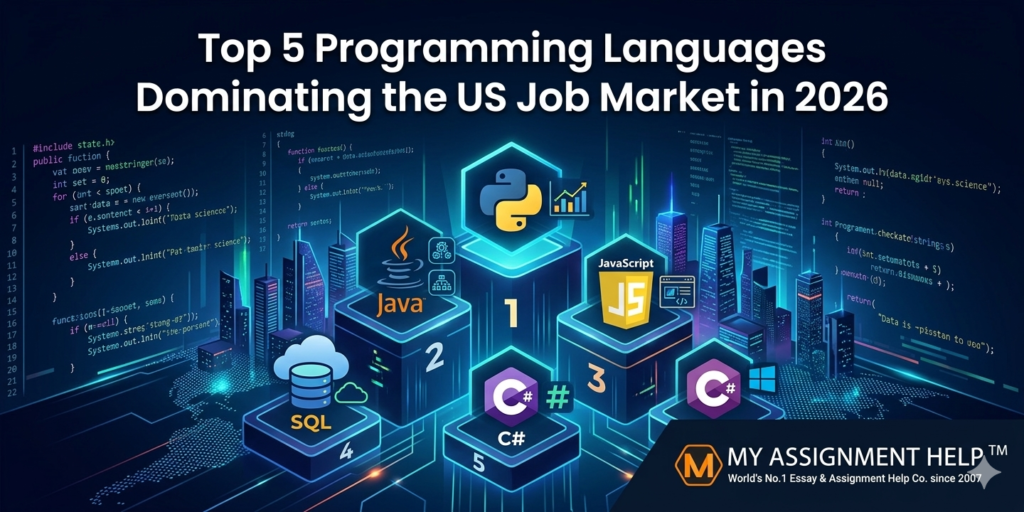
The American professional landscape has undergone a tectonic shift. In 2026, we no longer live in a traditional “degree economy” but rather a robust Skills Economy. As artificial intelligence (AI) transitions from a novel tool to a foundational layer of global infrastructure, the demand for specific programming proficiencies in the United States has reached an all-time high. According to recent Bureau of Labor Statistics (BLS) projections, employment for software developers is expected to grow by 15% through 2034, significantly outstripping the average for all other occupations.
However, the barrier to entry has evolved. Companies are no longer just looking for “coders”; they are seeking architects of intelligent systems who can blend algorithmic logic with AI-driven efficiency. For students navigating this rigorous environment, the pressure to maintain a high GPA while mastering industry-standard frameworks can be overwhelming. Many scholars now rely on professional programming homework help to bridge the gap between complex academic theory and the practical, production-ready code demanded by Silicon Valley and Wall Street alike.
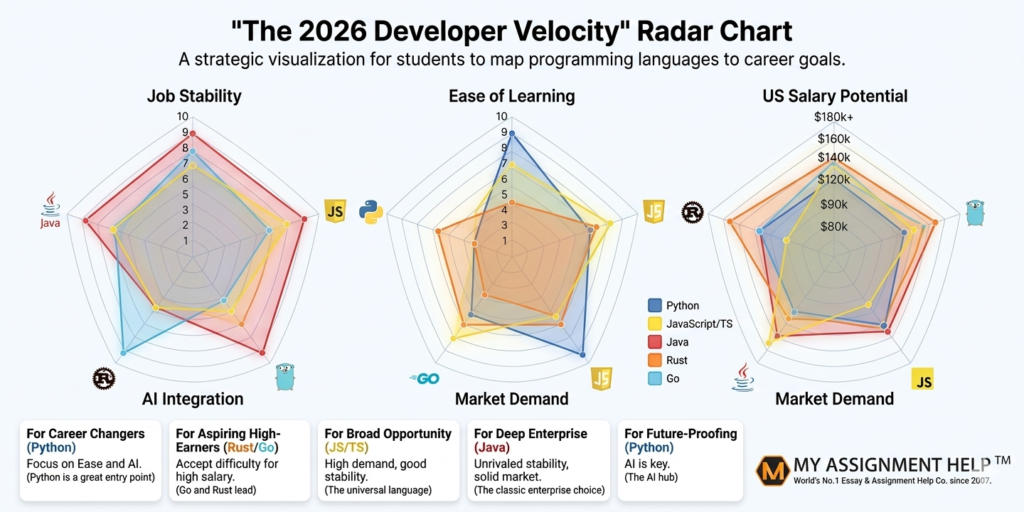
Whether you are a student or a transitioning professional, mastering these five languages is the most strategic move you can make to secure your spot in the US tech sector this year.
1. Python: The Undisputed King of the AI Era
Python’s trajectory from a versatile scripting language to the backbone of the AI revolution is complete. In 2026, it holds a dominant 22.6% share in global popularity rankings. In the US, it is the primary language for Machine Learning (ML), Natural Language Processing (NLP), and Data Science.
- Why it’s dominating: Libraries like TensorFlow, PyTorch, and scikit-learn have made Python the “lingua franca” of the AI world.
- US Market Value: Median salaries for Python-proficient Data Scientists in the US now exceed $150,000.
- Key Sectors: FinTech, Healthcare AI, and Autonomous Systems.
2. JavaScript & TypeScript: The Scalable Web Duo
While JavaScript remains the “king of the web,” 2026 has seen TypeScript become the mandatory standard for enterprise-level development. TypeScript’s static typing prevents the “runtime nightmares” that once plagued large-scale US web applications.
- The Shift: Over 43% of professional developers now utilize TypeScript for front-end and full-stack roles.
- US Market Value: Full-stack engineers proficient in React and Node.js remain some of the most sought-after hires in the New York and Austin tech hubs.
- Key Sectors: E-commerce, SaaS, and Digital Media.
3. Java: The Enterprise Workhorse
Despite the rise of newer languages, Java remains indispensable for the US banking and insurance sectors. Its “write once, run anywhere” philosophy powers the legacy and modern backend systems of the Fortune 500.
- Sustainability: Java continues to rank in the top 4 globally due to its unmatched stability and security.
- US Market Value: Enterprise Architects specializing in Java Spring Boot consistently earn top-tier compensation packages.
- Key Sectors: Global Finance, Android App Development, and Government Infrastructure.
4. Rust: The Gold Standard for System Safety
Rust has seen a meteoric rise due to its focus on memory safety and performance. With the US government increasingly pushing for “memory-safe” programming to bolster cybersecurity, Rust is no longer a niche language—it is a requirement for modern systems programming.
- Developer Sentiment: It remains the most admired language (72% approval) among US developers.
- Key Sectors: Cybersecurity, Operating Systems, and Cloud Infrastructure.
5. Go (Golang): The Cloud-Native Specialist
Designed by Google, Go has become the preferred language for the cloud-native revolution. As US companies migrate entirely to microservices and distributed systems, Go’s ability to handle high-concurrency tasks with ease has made it a top-5 contender.
- The Trend: 11% of developers globally intended to adopt Go by early 2026, with a heavy concentration in US-based DevOps roles.
- Key Sectors: Cloud Computing, Networking, and Backend Services.
The Evolving Developer Roadmap (2026)
Success in the current market requires more than just knowing a language; it requires “AI-Delegation” skills. Reports indicate that nearly 46% of code is now co-authored by AI assistants. The modern developer’s value lies in their ability to debug, architect, and verify AI-generated snippets for security vulnerabilities.
For those finding it difficult to keep up with these rapidly shifting requirements, a common strategy is to seek expert guidance. If you find yourself thinking, “I need to do my assignment but don’t have the time to master a new framework by Monday,” you aren’t alone. Balancing specialized projects with core curriculum is a skill in itself.
Key Takeaways
- Python is essential for anyone targeting the $200B+ US AI market.
- TypeScript has effectively replaced “Vanilla” JavaScript for professional enterprise roles.
- Rust is the future of secure systems, supported by federal cybersecurity initiatives.
- Human Oversight is the most valuable skill; AI writes the code, but humans must guarantee its integrity.
Frequently Asked Questions (FAQ)
Q1: Is a Computer Science degree still necessary in 2026?
While skills are prioritized, a Bachelor’s degree remains the “typical entry-level education” for US software roles, providing the foundational logic needed to manage AI tools effectively.
Q2: Which language should a beginner learn first?
Python remains the best starting point due to its readable syntax and its massive role in the 2026 AI-driven economy.
Q3: How much do software developers earn in the US currently?
As of 2026, the median pay for software developers is approximately $133,080 per year, with high-growth sectors like AI and Cybersecurity offering significantly more.
About the Author: Angelika S.
Angelika is a Senior Academic Specialist and Advisor at MyAssignmentHelp. With over a decade of experience in higher education strategy and technical SEO, she specializes in helping students navigate the intersection of academic rigor and professional career readiness. Her work focuses on translating complex global education trends into actionable insights for the next generation of tech leaders.